Sunday, May 21, 2006

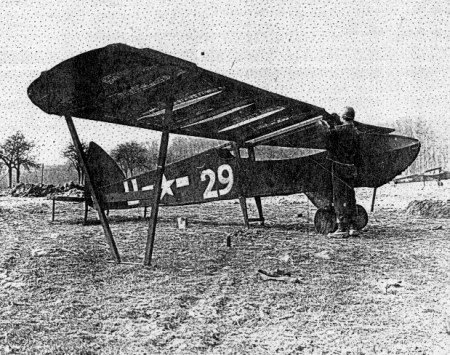
One of the 23rd Special Troops deception items:
A dummy plane used in France to deceive the
enemy (Courtesy Laynor Museum)
The ghost army consisted of 82 officers and 1,023 enlisted men. With their eclectic mixture of talents, they were strictly in the deception business. The Special Troops were made up of four units: a sonic deception company, a special radio company, a company of combat engineers, and a battalion of camoufleurs. They served with four armies in five European countries in five major campaigns from D-Day (June 6, 1944) until the end of the war in 1945.
The Special Troops used six major methods of deception: camouflaging troops and tanks, placing dummy tanks and artillery, firing pyrotechnics to simulate actual artillery fire, the use of artificial sound effects, using artificial radio communication, and using fake special effects. This created an atmosphere of great danger as they needed to be in close to front line battles.
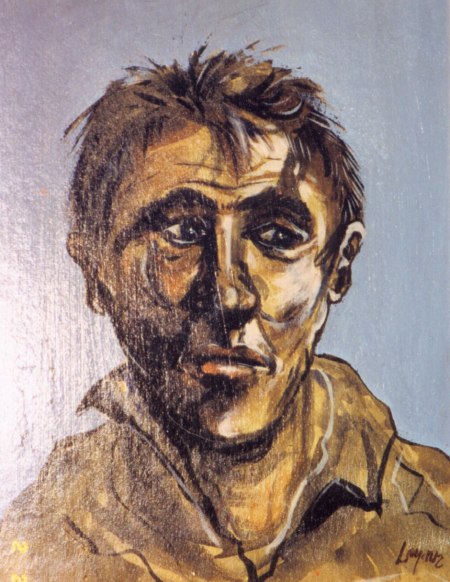
One of Dr. Harold Laynor's paintings
from World War II titled "YOUNG G.I."
(Courtesy Laynor Museum)
Although these brave men were involved in at least twenty other confrontations with the enemy, their biggest contribution was probably at the battle between Allied Forces and Germany at the Rhine River on March 23, 1945. Their contributions were essential in weakening the German assault and forcing Germany to surrender two months later in May of 1945.
Although records and information concerning the 23rd Headquarters Special Troops are sketchy, the aforementioned artist Harold Laynor (1922-1991) made a series of fifty paintings covering two years of participating in World War II. His works include paintings of army buddies, aspects of training and, as the series progresses, he relates the brutality and horror of war.
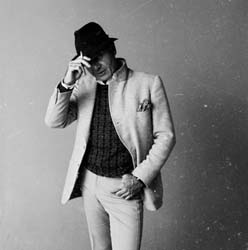
BILL BLASS (1922-2002)...The famous
fashion designer as seen in 1972. He was
a member of the American "ghost army" of
World War II. (Jackie Robinson Archive)
Like the above mentioned celebrities participating in the 23rd, Dr. Laynor was highly distinguished in his field. Although he used primarily watercolors for his World War II work, he was also a pioneer in the use of lacquer as a medium of painting and the use of 3D paintings for the blind.
The Laynor Foundation website (www.laynor.org) has valuable information concerning the ghost army and also features seven galleries of Dr. Laynor’s World War II paintings. They are very interesting and illustrative of that terrible time in our history.
Optical illusions, bluffs, sleight of hand, misinformation, disappearing acts: all part of the ghost army of World War II; a brave and cunning bunch of guys who were instrumental in giving us the lifestyle we enjoy today. (Comments? Questions? azjimmcallister@cox.net)

Monday, May 15, 2006

THE BIG BANDS: SWING, JAZZ, AND BENNY GOODMAN

by Jim McAllister

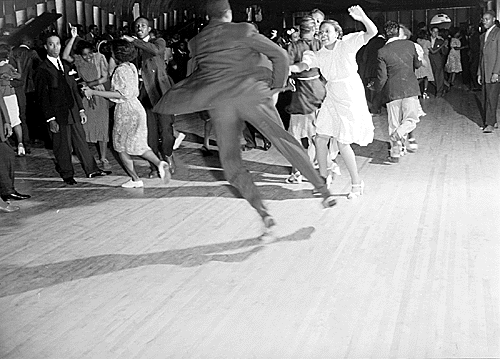
Once upon a time in America couples actually touched each other while dancing. Not only that, if you really got into "fast" dancing you needed some athletic ability plus you better be in good physical shape. If you see movies such as "Cabin in the Sky" (1943), The Marx Brothers’ "A Day at the Races" (1937) or "Hellzapoppin’" (1941), you will see dancing being performed that will take your breath away. Popularly known as "jitterbugging" or "swing dancing" many years ago, this style was originally an outgrowth from a popular dance in the 1920's called the "Lindy Hop", named after transatlantic crossing aviator Charles Lindbergh.
In the 1920's, the so-called society orchestras played a ragtime style dance music that included a lot of strings. By the latter part of the decade, artists like Louis Armstrong were breaking away from that style fronting smaller groups consisting mainly of brass sections, piano, and drums. As the 1930's emerged these "swing" bands became larger and louder (they were now known as "Big Bands") and were led by such future stars as the Dorsey brothers, Cab Calloway, Glenn Miller, Count Basie, Artie Shaw, and Benny Goodman.
Jitterbugging in Harlem in 1939. (Museum of City
of New York, Sid Grossman, photographer)
Since this was considered a drastic change to the popular music and dancing scene, there was much consternation from previous generations much like that experienced in the 1950's by Elvis and in the 1960's by The Beatles. I tend to pick Benny Goodman as the harbinger responsible for the success of Big Band jazz and swing. January 18, 1938 is an important date in this movement as that was when promoter Sol Hurok booked Goodman and his band into the most prestigious venue in the country, Carnegie Hall. Goodman had experienced some hard earned success before the Hall date, but that was the benchmark for all others who followed.
Benny Goodman was born in Chicago on May 30, 1909 and was part of a family of twelve. By the age of 16 he was playing clarinet for various bands and by 1933 was doing recordings with drummer Gene Krupa and trombonist Jack Teagarden. He led his first band in 1934 and then was engaged to perform on radio via NBC’s "Let’s Dance". He also performed on the "National Biscuit Saturday Night" broadcasts. Although he also played standards that appealed to the masses during the day on New York radio, the late night programming allowed him to play his own type of music. Although New York didn’t hear much of these late night broadcasts, the kids in California did because of the three hour time difference. This would later prove to be a major factor in Goodman’s success.
CAB CALLOWAY (1907-1994)...The "Hi-de-hi,
Hi-de-ho" man. Calloway was a great
entertainer with his orchestra, singing, and
dancing. (Cab Calloway photo gallery)
In the spring of 1934 Benny and the band took off on a summer tour. Although they had Benny’s music, they were told to stay with the standards because of the complaints of the older ballroom dancers about the new style of the band. Refusing to acquiesce to this demand, the tour was becoming a failure as fewer people were showing up to hear the new sound. As plans to disband the tour were discussed, they reached California. The first stop was Oakland where lines of young people extended around the block to get into Sweet’s Ballroom to "jitterbug" the night away to the sound of Benny’s music. He was happy with this success but considered it more as a one time situation than any sort of breakthrough. However, when the band reached the Palomar Ballroom in Los Angeles for the last stop on the tour, the crowds of kids and adults were there to greet him and dance the night away again. The band stayed at the Palomar for a two month gig before heading back east wallowing in the success of the West Coast dates. Thanks to the East Coast-West Coast time difference of three hours, Benny Goodman had become a star through his late night radio broadcasts.
BENNY GOODMAN...His concert of
January 18, 1938 at Carnegie Hall
established him as the "King of Swing"
(Photo: David Mulliss)
More success was attained in Chicago and then it was on to New York to pack them in at the Paramount Theater where kids waited for hours to get in and jitterbug in the aisles. At the age of 28, Benny Goodman was practically at the pinnacle of his profession as he was now featured on the Camel Caravan radio program and receiving rave reviews from the critics and fans. Then there was January 18, 1938, the date that he received his final approval with the Carnegie Hall gig. Benny Goodman was truly the "King of Swing".
The swing era began to fade a bit as World War II progressed, but Benny Goodman’s influence was felt as he was responsible for many kids getting into music and working in particular with the clarinet. He later played some classic compositions as a soloist with noted orchestras around the world. He had played with the best jazz and swing artists of his time and remained the King of Swing until his death in June of 1986 at the age off 77. (Comments? Questions? azjimmcallister@cox.net)

Monday, May 08, 2006

THE 2006 MCDOWELL MOUNTAIN MUSIC FESTIVAL

by Jim McAllister

It has been one year since I reviewed The McDowell Mountain Music Festival number two. It was a great event and the 2006 event that took place Friday and Saturday, April 28 and 29, was even better. Think about it: For fifty bucks you get to enjoy an entire day on the polo field of Westworld in Scottsdale and listen to some great bands perform from noon until eleven o’clock at night. Fifty bucks won’t even get you close to a Madonna concert or any other notable act, so this was a great deal.
The 2006 MCDOWELL MOUNTAIN MUSIC
FESTIVAL (Photo: McDowell Mountain Music
Festival)
The Festival also is a family friendly event as there was a craft center and other activities to keep the kids busy. Once again the proceeds of an expected $30,000 will be donated to the Boys Hope, Girls Hope foundation and the Phoenix Day Child and Family Learning Centers.
This year’s setup looked about the same as last year’s with plenty of food and drink booths on the perimeter of the field. There was the artist’s colony section with some nifty stuff and the obligatory tacky items and, of course, tee shirts were available. I’m glad the organizers haven’t gone overboard with the booths, enough is enough with that sort of attraction .With the heat of Saturday I was thankful for the suds available at the Sierra Nevada beer booth. I also was glad I lathered down with sun block as the sun was shining in all of its Arizona glory.
The music at The McDowell Mountain Music Festival just keeps getting better. Last year was good with well known acts like Bruce Hornsby and Solomon Burke performing along with good but lesser known acts. This year was an improvement as Friday’s lineup included the multi platinum Black Crowes as the featured act of a day that included Traveler, The Pistoleros, Tishamingo, Son Volt, and Buckwheat Zydeco.
BURNING SPEAR...The reggae artist performed
on a hot Scottsdale afternoon at the McDowell
Mountain Music Festival. (Photo: Burning Spear)
On Saturday, the entertainment level was kicked up a notch as nine acts made their way to the stage. I arrived in time to see the end of event co-organizer Walt Richardson’s set. Following Richardson was the master of reggae, Burning Spear. This guy has been around for over thirty-five years and, along with his band, put on quite a show. A large crowd cheered enthusiastically and since there was accessability for fans to get close to the stage, there was plenty of dancing. Spear’s band was great and for a moment, I thought I heard a guitar riff similar to the one in Norman Greenbaum’s "Spirit in the Sky" from 1970. Could it be? Did that lead guitar player for Spear give me a nod of appreciation for noticing that? I would like to think so.
THE MARSHALL TUCKER BAND...A favorite
from the 1970's, they thrilled the large crowd
on Saturday night at The McDowell Mountain
Music Festival (Photo: Yahoo.com)
After Burning Spear came Ozomatli, a group with a sound very different from the smooth reggae tones of Burning Spear. I would describe their sound as a mix of rap, Latin, hip-hop, all with a middle eastern background. Does that sound a bit different to you? I assure you that it was but some of their tunes were pretty good as I enjoyed the mysterious air to them with the middle eastern sound. Whatever it was they did, their fans were appreciative as the crowds were enlarging and getting more boisterous with their cheering and dancing. Evening was approaching and full blown party time was nearing.
Saturday night brought 1970's favorite, The Marshall Tucker Band, popular rock and soul guitarist Johnny Lang, and three time Grammy winning Los Lobos. That concluded a great day and weekend of music and fun at the 2006 McDowell Mountain Music Festival.