by Jim McAllister
"Screwball" comedy was popular in Hollywood films from about 1934 until the early 1940's. Last November I devoted two columns (11-9, 11-16) to discussing the musicals of the same period and how their purpose was to cheer up audiences of the Depression and try to make them really believe that "We’re in the Money". The screwball comedies were designed to do basically the same thing during the same period and, like the musicals, they usually added a bit of commentary to their stories.
Monday, May 29, 2006


What were the screwball comedies about? The word "screwball" came about in the early 20th century and meant "crazy" or "insane" so the first thing one notices when discussing these films is the fast pacing and frenetic or crazy action. A good example of this is the 1940 entry, "His Girl Friday" starring Cary Grant and Rosalind Russell. Another trait is the story line which usually involves the breakup of a romance, as one or both partners decide they can’t stand the other, and gets involved with another person. Usually, through a rough and tumble story, they eventually find that they can’t live without each other after all. The dialogue is almost always sophisticated and slapstick comedy can be involved. Somebody or some thing is usually being laughed at such as in "My Man Godfrey" (1936) where the rich are being skewered during the height of the Depression for their frivolous spending while others starved.
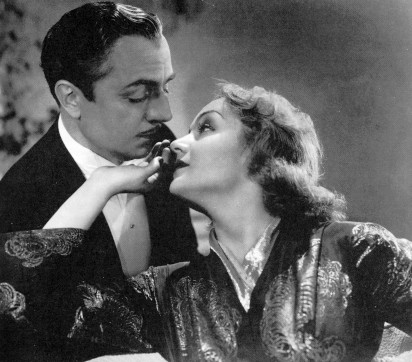
WILLIAM POWELL and CAROLE LOMBARD
in MY MAN GODFREY. Made in 1936, it was
a good example of "screwball" commentary with
its portrayal of the wealthy during the Depression.
Powell and Lombard were married briefly in the
1930's. He lived to be 92, she died tragically in
a plane crash in 1942 at 34 while on a war bond rally
trip. She was married to Clark Gable at the time;
he never fully recoverd from her death. (Modern
Times)

in MY MAN GODFREY. Made in 1936, it was
a good example of "screwball" commentary with
its portrayal of the wealthy during the Depression.
Powell and Lombard were married briefly in the
1930's. He lived to be 92, she died tragically in
a plane crash in 1942 at 34 while on a war bond rally
trip. She was married to Clark Gable at the time;
he never fully recoverd from her death. (Modern
Times)
When watching a screwball comedy, one will notice that although there is a lot of sexual innuendo, there isn’t much in the way of sex. Had these movies been made before 1934 this may have been different, but 1934 was the year that Joseph Breen took over the administration of the Hollywood Production Code and started enforcing the Hays Code of 1930. Hence, Frank Capra had to be careful in the first successful screwball comedy, "It Happened One Night" (1934). Clark Gable was allowed to take off his shirt to reveal a bare chest in the motel room but with a blanket dividing the room between him and Claudette Colbert. (Note: that scene almost ruined the undershirt makers as men wanted to be like the ultra cool Gable and quit wearing undershirts.) "It Happened One Night" also incorporated a couple more traits of screwball comedy: strong willed women, and wealth by one or both parties. In this case, Colbert is the strong willed, runaway heiress being chased by reporter Gable and her harried father, Walter Connolly. A similar role is that of Carole Lombard in "My Man Godfrey". It’s hard to think of Lombard as anything but strong willed as she played a similar personality in other screwball favorites, "Nothing Sacred" (1937), "Twentieth Century" (1934), and "Mr. And Mrs. Smith" (1941).
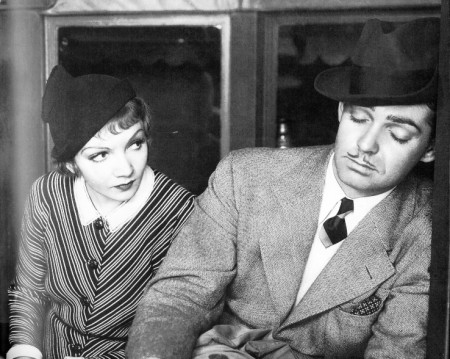
CLAUDETTE COLBERT and CLARK GABLE
in IT HAPPENED ONE NIGHT. Gable was loaned
to poverty row Columbia Pictures by MGM as
punishment for asking for more money. Col-
bert originally had no interest in the movie. Result:
IT HAPPENED ONE NIGHT won Best Movie Oscar
for 1934, Best Actress: Colbert, Best Director: Frank
Capra, Best Screenplay: Robert Riskin. Truly "screwball"!
(Modern Times)
in IT HAPPENED ONE NIGHT. Gable was loaned
to poverty row Columbia Pictures by MGM as
punishment for asking for more money. Col-
bert originally had no interest in the movie. Result:
IT HAPPENED ONE NIGHT won Best Movie Oscar
for 1934, Best Actress: Colbert, Best Director: Frank
Capra, Best Screenplay: Robert Riskin. Truly "screwball"!
(Modern Times)
William Powell and Myrna Loy starred in "The Thin Man" series of six films produced between 1934 and 1947. These entries exemplified the screwball touch. Nick and Nora Charles (Powell and Loy) were characters invented by Dashiell Hammett and "The Thin Man" movies had it all: plenty of wealth, some slapstick, misunderstandings, a lot of drinking, a strong female lead, and a good final resolution. They are fast paced, funny, sophisticated, and well worth watching.
Some of the Hollywood’s best were well suited for screwball comedy. They were all good looking, classy performers who weren’t afraid to take a pratfall or get a pie in the face. I have mentioned Cary Grant, Rosalind Russell, Carole Lombard, Gable and Colbert, and Powell and Loy. Others were also good such as: Melvyn Douglas ("Ninotchka" (1939) with Greta Garbo), Jean Arthur (The Ex-Mrs. Bradford (1936) with Powell), and Ginger Rogers ("Bachelor Mother" (1939) with David Niven).
Some of the Hollywood’s best were well suited for screwball comedy. They were all good looking, classy performers who weren’t afraid to take a pratfall or get a pie in the face. I have mentioned Cary Grant, Rosalind Russell, Carole Lombard, Gable and Colbert, and Powell and Loy. Others were also good such as: Melvyn Douglas ("Ninotchka" (1939) with Greta Garbo), Jean Arthur (The Ex-Mrs. Bradford (1936) with Powell), and Ginger Rogers ("Bachelor Mother" (1939) with David Niven).
A lot of popular character actors inhabited these movies too. Among them were Edward Everett Horton, the above mentioned Walter Connolly, Franklin Pangborn, the ever rotund Eugene Pallette, Alan Mowbray, and Edward Arnold.
Although there were a few more screwball films made in the 1940's, the style had pretty much run its course by the early 1940's. With the onset of World War II, the Depression finally ended and with it the feeling for frivolity. War pictures became popular as part of the fighting mentality and people turned their attention to more serious matters. The day of the screwball comedy was basically over but not forgotten by the Depression audiences of the 1930's.
Although there were a few more screwball films made in the 1940's, the style had pretty much run its course by the early 1940's. With the onset of World War II, the Depression finally ended and with it the feeling for frivolity. War pictures became popular as part of the fighting mentality and people turned their attention to more serious matters. The day of the screwball comedy was basically over but not forgotten by the Depression audiences of the 1930's.
Sunday, May 21, 2006
THE "GHOST ARMY" OF WORLD WAR II
(Author's note: This article was originally published on April 27, 2005 in the INDEPENDENT. I was fascinated by the story of the ghost army and the bravery of those guys in World War II and, with Memorial Day arriving in another week, I feel a tribute to them and our current fighting forces is appropriate with a reprint of that column....JM
by Jim McAllister
I’m sure you are wondering, "What in the world was the ghost army of World War II?" It’s an interesting story that I will explain in this column.
Ever since warfare has existed, armies have relied on some type of deception to gain an advantage on their opponents. Some ancient armies used plaster dummies, others used fake smoke signals and spies, and we all know about the famous Trojan horse. These ancient examples of deception were carried into modern warfare during World War II with the exploits of the ghost army or their actual title which was the 23rd Headquarters Special Troops.
The ghost army was a unique and little known group of American soldiers who played a big part in the Allied victory over Germany through their abilities in the art of deception. Even though information on this unit became available about thirty years ago, not much has been written about them. As World War II faded into history, so did the 23rd Special Troops.
The ghost army was organized by Lieutenant Colonel Merrick Truly. He was the executive officer in charge of these deception experts. Although Truly’s men reported to the American ground commander in Europe, General Omar Bradley, most of the American soldiers did not know of the existence of the Special Troops. They operated at night under strictly special orders and were not even required to give their identity to superior officers.
by Jim McAllister
I’m sure you are wondering, "What in the world was the ghost army of World War II?" It’s an interesting story that I will explain in this column.
Ever since warfare has existed, armies have relied on some type of deception to gain an advantage on their opponents. Some ancient armies used plaster dummies, others used fake smoke signals and spies, and we all know about the famous Trojan horse. These ancient examples of deception were carried into modern warfare during World War II with the exploits of the ghost army or their actual title which was the 23rd Headquarters Special Troops.
The ghost army was a unique and little known group of American soldiers who played a big part in the Allied victory over Germany through their abilities in the art of deception. Even though information on this unit became available about thirty years ago, not much has been written about them. As World War II faded into history, so did the 23rd Special Troops.
The ghost army was organized by Lieutenant Colonel Merrick Truly. He was the executive officer in charge of these deception experts. Although Truly’s men reported to the American ground commander in Europe, General Omar Bradley, most of the American soldiers did not know of the existence of the Special Troops. They operated at night under strictly special orders and were not even required to give their identity to superior officers.

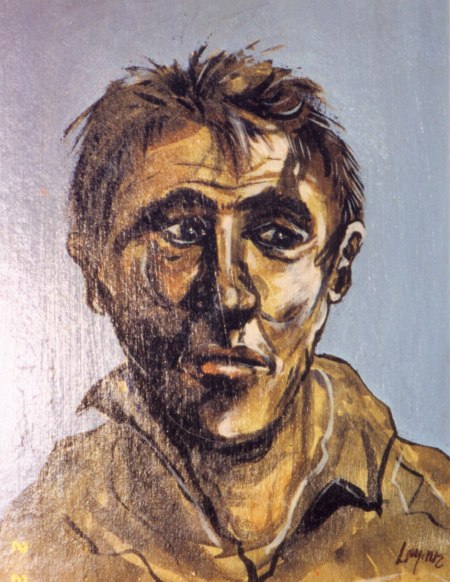
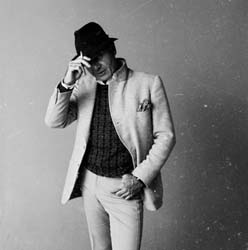
The most unique part of this already unique group was the composition of its members. Many of these men were already famous as artists, sculptors, architects, literary figures, and others from the world of the arts and humanities. Actor Douglas Fairbanks, Jr. was perhaps the most well known for his Hollywood successes, but there was also renowned fashion designer Bill Blass, Olin Dows: a prominent artist, George Diestal: a Hollywood set designer, Art Kane: a fashion photographer, and Harold Laynor, whose artistic works depicting World War II and other subjects, are shown in galleries throughout the country.
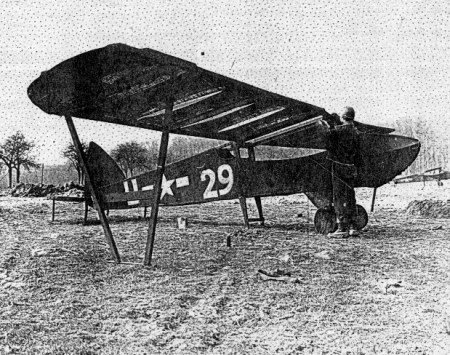
The ghost army consisted of 82 officers and 1,023 enlisted men. With their eclectic mixture of talents, they were strictly in the deception business. The Special Troops were made up of four units: a sonic deception company, a special radio company, a company of combat engineers, and a battalion of camoufleurs. They served with four armies in five European countries in five major campaigns from D-Day (June 6, 1944) until the end of the war in 1945.
The Special Troops used six major methods of deception: camouflaging troops and tanks, placing dummy tanks and artillery, firing pyrotechnics to simulate actual artillery fire, the use of artificial sound effects, using artificial radio communication, and using fake special effects. This created an atmosphere of great danger as they needed to be in close to front line battles.
The Special Troops used six major methods of deception: camouflaging troops and tanks, placing dummy tanks and artillery, firing pyrotechnics to simulate actual artillery fire, the use of artificial sound effects, using artificial radio communication, and using fake special effects. This created an atmosphere of great danger as they needed to be in close to front line battles.
Although these brave men were involved in at least twenty other confrontations with the enemy, their biggest contribution was probably at the battle between Allied Forces and Germany at the Rhine River on March 23, 1945. Their contributions were essential in weakening the German assault and forcing Germany to surrender two months later in May of 1945.
Although records and information concerning the 23rd Headquarters Special Troops are sketchy, the aforementioned artist Harold Laynor (1922-1991) made a series of fifty paintings covering two years of participating in World War II. His works include paintings of army buddies, aspects of training and, as the series progresses, he relates the brutality and horror of war.
Although records and information concerning the 23rd Headquarters Special Troops are sketchy, the aforementioned artist Harold Laynor (1922-1991) made a series of fifty paintings covering two years of participating in World War II. His works include paintings of army buddies, aspects of training and, as the series progresses, he relates the brutality and horror of war.
Like the above mentioned celebrities participating in the 23rd, Dr. Laynor was highly distinguished in his field. Although he used primarily watercolors for his World War II work, he was also a pioneer in the use of lacquer as a medium of painting and the use of 3D paintings for the blind.
The Laynor Foundation website (www.laynor.org) has valuable information concerning the ghost army and also features seven galleries of Dr. Laynor’s World War II paintings. They are very interesting and illustrative of that terrible time in our history.
Optical illusions, bluffs, sleight of hand, misinformation, disappearing acts: all part of the ghost army of World War II; a brave and cunning bunch of guys who were instrumental in giving us the lifestyle we enjoy today. (Comments? Questions? azjimmcallister@cox.net)
The Laynor Foundation website (www.laynor.org) has valuable information concerning the ghost army and also features seven galleries of Dr. Laynor’s World War II paintings. They are very interesting and illustrative of that terrible time in our history.
Optical illusions, bluffs, sleight of hand, misinformation, disappearing acts: all part of the ghost army of World War II; a brave and cunning bunch of guys who were instrumental in giving us the lifestyle we enjoy today. (Comments? Questions? azjimmcallister@cox.net)
Monday, May 15, 2006
THE BIG BANDS: SWING, JAZZ, AND BENNY GOODMAN
by Jim McAllister
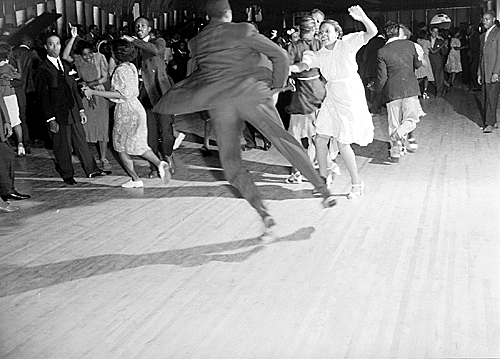
Once upon a time in America couples actually touched each other while dancing. Not only that, if you really got into "fast" dancing you needed some athletic ability plus you better be in good physical shape. If you see movies such as "Cabin in the Sky" (1943), The Marx Brothers’ "A Day at the Races" (1937) or "Hellzapoppin’" (1941), you will see dancing being performed that will take your breath away. Popularly known as "jitterbugging" or "swing dancing" many years ago, this style was originally an outgrowth from a popular dance in the 1920's called the "Lindy Hop", named after transatlantic crossing aviator Charles Lindbergh.
In the 1920's, the so-called society orchestras played a ragtime style dance music that included a lot of strings. By the latter part of the decade, artists like Louis Armstrong were breaking away from that style fronting smaller groups consisting mainly of brass sections, piano, and drums. As the 1930's emerged these "swing" bands became larger and louder (they were now known as "Big Bands") and were led by such future stars as the Dorsey brothers, Cab Calloway, Glenn Miller, Count Basie, Artie Shaw, and Benny Goodman.
Once upon a time in America couples actually touched each other while dancing. Not only that, if you really got into "fast" dancing you needed some athletic ability plus you better be in good physical shape. If you see movies such as "Cabin in the Sky" (1943), The Marx Brothers’ "A Day at the Races" (1937) or "Hellzapoppin’" (1941), you will see dancing being performed that will take your breath away. Popularly known as "jitterbugging" or "swing dancing" many years ago, this style was originally an outgrowth from a popular dance in the 1920's called the "Lindy Hop", named after transatlantic crossing aviator Charles Lindbergh.
In the 1920's, the so-called society orchestras played a ragtime style dance music that included a lot of strings. By the latter part of the decade, artists like Louis Armstrong were breaking away from that style fronting smaller groups consisting mainly of brass sections, piano, and drums. As the 1930's emerged these "swing" bands became larger and louder (they were now known as "Big Bands") and were led by such future stars as the Dorsey brothers, Cab Calloway, Glenn Miller, Count Basie, Artie Shaw, and Benny Goodman.
Subscribe to:
Posts (Atom)